Feature Computation
01-feature-computation.Rmd
library(CellTFusion)
#>
#>
CellTFusion combines two families of features computed from bulk
RNAseq data: cell-type deconvolution proportions and
transcription factor (TF) activity scores, further
summarized into TF co-activity modules and pathway activities. This
article walks through each function individually — what it does, its key
arguments, and the plots/objects it produces. All of these steps are run
automatically, in the right order, by the CellTFusion()
wrapper (see the package README); read this
article if you want to run, inspect, or customize each stage on its
own.
Load the pre-packaged example data:
raw.counts <- CellTFusion::raw.counts.tuto
traitdata  <- CellTFusion::traitdata.tuto
1. Normalization
Before TF activity or pathway scoring, raw counts are normalized to
log2(TPM + 1). Deconvolution methods use TPM without the log transform,
and this step is handled internally by
compute.deconvolution().
counts.norm <- data.frame(ADImpute::NormalizeTPM(raw.counts, log = TRUE))2. Cell-type deconvolution
Cell-type proportions are estimated with
compute.deconvolution() from the companion multideconv
package, which wraps multiple deconvolution algorithms (Quantiseq,
Epidish, DeconRNASeq, DWLS, CIBERSORTx) and averages/combines their
outputs into a single feature matrix (samples x cell-type/method
combinations).
Key arguments:
-
raw.counts— raw counts matrix (genes x samples). -
methods— deconvolution algorithms to run. -
normalized— set toTRUEifraw.countsis already normalized (the function otherwise normalizes internally to TPM). -
credentials.mail/credentials.token— required only if"CBSX"(CIBERSORTx) is included inmethods. -
return— ifTRUE, saves the resulting matrix toResults/.
deconv <- multideconv::compute.deconvolution(
  raw.counts,
  methods    = c("Quantiseq", "Epidish"),
  normalized = TRUE,
  return     = FALSE
)
#> Performing TPM normalization ................................................................................
#> Converting input to matrix.
#> Running deconvolution using the following methods...............................................................
#>
#> * Quantiseq
#> * Epidish
#>
#> Running Quantiseq...............................................................
#>
#> >>> Running quantiseq
#>
#> Running quanTIseq deconvolution module
#> Gene expression normalization and re-annotation (arrays: FALSE)
#> Removing 17 noisy genes
#> Removing 15 genes with high expression in tumors
#> Signature genes found in data set: 128/138 (92.75%)
#> Mixture deconvolution (method: lsei)
#> Deconvolution successful!
#>
#> The following method-signature combinations are going to be calculated...............................................................
#>
#> Methods
#> * Epidish
#>
#> Signatures
#> * CBSX-HNSCC-scRNAseq
#> * CBSX-Melanoma-scRNAseq
#> * CBSX-NSCLC-PBMCs-scRNAseq
#> * CBSX-Vanderbilt-scRNAseq
#> * CBSX-Zilionis-scRNAseq
#> * LM22
#> * TIL10
#>
#> Running Epidish...............................................................
#>
#>
#> Running Epidish...............................................................
#>
#>
#> Running Epidish...............................................................
#>
#>
#> Running Epidish...............................................................
#>
#>
#> Running Epidish...............................................................
#>
#>
#> Running Epidish...............................................................
#>
#>
#> Running Epidish...............................................................
#>
#> Deconvolution cache files removed.
#> Preprocessing deconvolution features...............................................................
#>
#> Checking consistency in deconvolution cell fractions across patients...............................................................
#>
#> No extra cell types provided. Only the following cell types will be considered:
#>  B.cells
#> B.naive.cells
#> B.memory.cells
#> Macrophages.cells
#> Macrophages.M0
#> Macrophages.M1
#> Macrophages.M2
#> Monocytes
#> Neutrophils
#> NK.cells
#> NK.activated
#> NK.resting
#> NKT.cells
#> CD4.cells
#> CD4.memory.activated
#> CD4.memory.resting
#> CD4.naive
#> CD8.cells
#> CD4.regulatory
#> CD4.non.regulatory
#> T.cells.helper
#> T.cells.gamma.delta
#> Dendritic.cells
#> Dendritic.activated.cells
#> Dendritic.resting.cells
#> Cancer
#> Endothelial
#> Eosinophils
#> Plasma
#> Myocytes
#> Fibroblast
#> Mast.cells
#> Mast.activated.cells
#> Mast.resting.cells
#> CAF
#> uncharacterized_cell
#>
#> If you want to consider other cell types (e.g. from a custom signature) which are not included in the package by default (see README), please provide them in the cells_extra argument.
#>
#> Total sum across samples of combination Quantiseq_TIL10 is 1
#> Total sum across samples of combination Epidish_CBSX.HNSCC.scRNAseq is 1
#> Total sum across samples of combination Epidish_CBSX.Melanoma.scRNAseq is 1
#> Total sum across samples of combination Epidish_CBSX.NSCLC.PBMCs.scRNAseq is 1
#> Total sum across samples of combination Epidish_CBSX.Vanderbilt.scRNAseq is 1
#> Total sum across samples of combination Epidish_TIL10 is 1
#> Total sum across samples of combination Epidish_CBSX.Zilionis.scRNAseq is 1
#> Total sum across samples of combination Epidish_LM22 is 1
head(deconv[, 1:5])
#>                 Quantiseq_TIL10_B.cells Epidish_CBSX.HNSCC.scRNAseq_B.cells
#> SAM7f0d9cc7f001             0.050210988                         0.025626151
#> SAM4305ab968b90             0.008603929                         0.000000000
#> SAMcf018fee2acd             0.042857608                         0.080914523
#> SAMcc4675f394a1             0.025216439                         0.001434758
#> SAM49f9b2e57aa5             0.022668958                         0.137032856
#> SAM2e7aa8fa0ab3             0.012022510                         0.282602048
#>                 Epidish_CBSX.Melanoma.scRNAseq_B.cells
#> SAM7f0d9cc7f001                            0.066233918
#> SAM4305ab968b90                            0.008756584
#> SAMcf018fee2acd                            0.009133098
#> SAMcc4675f394a1                            0.000000000
#> SAM49f9b2e57aa5                            0.036205984
#> SAM2e7aa8fa0ab3                            0.005377105
#>                 Epidish_CBSX.NSCLC.PBMCs.scRNAseq_B.cells
#> SAM7f0d9cc7f001                                 0.9270601
#> SAM4305ab968b90                                 0.7335563
#> SAMcf018fee2acd                                 0.8704203
#> SAMcc4675f394a1                                 0.7806137
#> SAM49f9b2e57aa5                                 0.7666496
#> SAM2e7aa8fa0ab3                                 0.9091358
#>                 Epidish_CBSX.Vanderbilt.scRNAseq_B.cells
#> SAM7f0d9cc7f001                                        0
#> SAM4305ab968b90                                        0
#> SAMcf018fee2acd                                        0
#> SAMcc4675f394a1                                        0
#> SAM49f9b2e57aa5                                        0
#> SAM2e7aa8fa0ab3                                        0
3. TF activity inference
TF activity per sample is inferred with
compute.TFs.activity() from normalized expression using a
VIPER/consensus-scoring approach (via decoupleR) (Alvarez et al.
2016), combined with a regulon (TF-target network).
Key arguments:
-
RNA.counts— normalized expression matrix (genes x samples), typically log2(TPM+1). -
TF.collection— source of the TF-target regulon:-
"CollecTRI"(default) (Müller-Dott et al. 2023) and"Dorothea"are curated, literature-derived regulons fetched automatically from OmnipathR. -
"ARACNE"uses a data-driven, cohort-specific regulatory network reverse-engineered from expression data with the ARACNe algorithm (Margolin et al. 2006) (Algorithm for the Reconstruction of Accurate Cellular Networks), instead of a generic literature-derived network. ARACNe infers TF-target edges from mutual information between gene expression profiles across the cohort, followed by removal of indirect interactions via the Data Processing Inequality. This is useful when you have a large cohort of samples from the same cancer type/context and want TF-target relationships inferred directly from its co-expression structure rather than relying on curated interactions that may not hold in that tissue — at the cost of requiring a sizeable, homogeneous cohort to estimate mutual information reliably. It requires a pre-computed 3-column network file (regulator,target,mutual information) located atinput/ARACNE/<cancer.type>/network/network.txt; pass the corresponding label viacancer.type.
-
-
min_targets_size— minimum number of target genes required per regulon (TFs with fewer targets are dropped). Default is 5; increasing it keeps only better-supported TFs. -
universe— optional user-supplied regulon (data frame of TF-target interactions), bypassing the automatic OmnipathR/ARACNE fetch. -
cores— number of cores used for the activity inference. -
scale— ifTRUE(default), z-scores TF activity across samples.
tfs <- compute.TFs.activity(
  RNA.counts       = counts.norm,
  TF.collection    = "CollecTRI",
  min_targets_size = 5,
  cores            = 3,
  return           = TRUE
)
head(tfs[, 1:5])
You can also supply a pre-built regulon directly via
universe:
universe <- decoupleR::get_collectri(organism = "human", split_complexes = FALSE)
tfs <- compute.TFs.activity(counts.norm, universe = universe)
Or use a cohort-specific ARACNe network:
tfs_aracne <- compute.TFs.activity(
  RNA.counts    = counts.norm,
  TF.collection = "ARACNE",
  cancer.type   = "skcm"   # matches input/ARACNE/skcm/network/network.txt
)
4. TF co-activity modules
TF activity scores (potentially hundreds of TFs) are reduced into a
small number of co-activity modules using
compute.WTCNA(), an implementation of Weighted TF
Co-activity Network Analysis (WTCNA), an adaptation of WGCNA (Langfelder and
Horvath 2008) applied to TFs instead of genes. Each module
gets one sample-level score (its eigengene).
Key arguments:
-
TFs.matrix— TF activity matrix (or, ifbatch = TRUE, a list of per-cohort matrices) fromcompute.TFs.activity(). -
batch— ifTRUE, runs consensus WGCNA across cohorts instead of a single-matrix analysis (see the Batch/Multi-cohort Analysis article for details). -
network.type—"signed"(default),"unsigned","signed hybrid", or"distance". -
minMod— minimum number of TFs required to form a module. -
corr_mod— correlation threshold for merging similar modules. -
cor_type—"p"(Pearson) or"s"(Spearman).
network <- compute.WTCNA(
  TFs.matrix        = tfs,
  batch             = FALSE,
  network.type      = "signed",
  clustering.method = "ward.D2",
  minMod            = 15,
  corr_mod          = 0.9,
  return            = TRUE
)
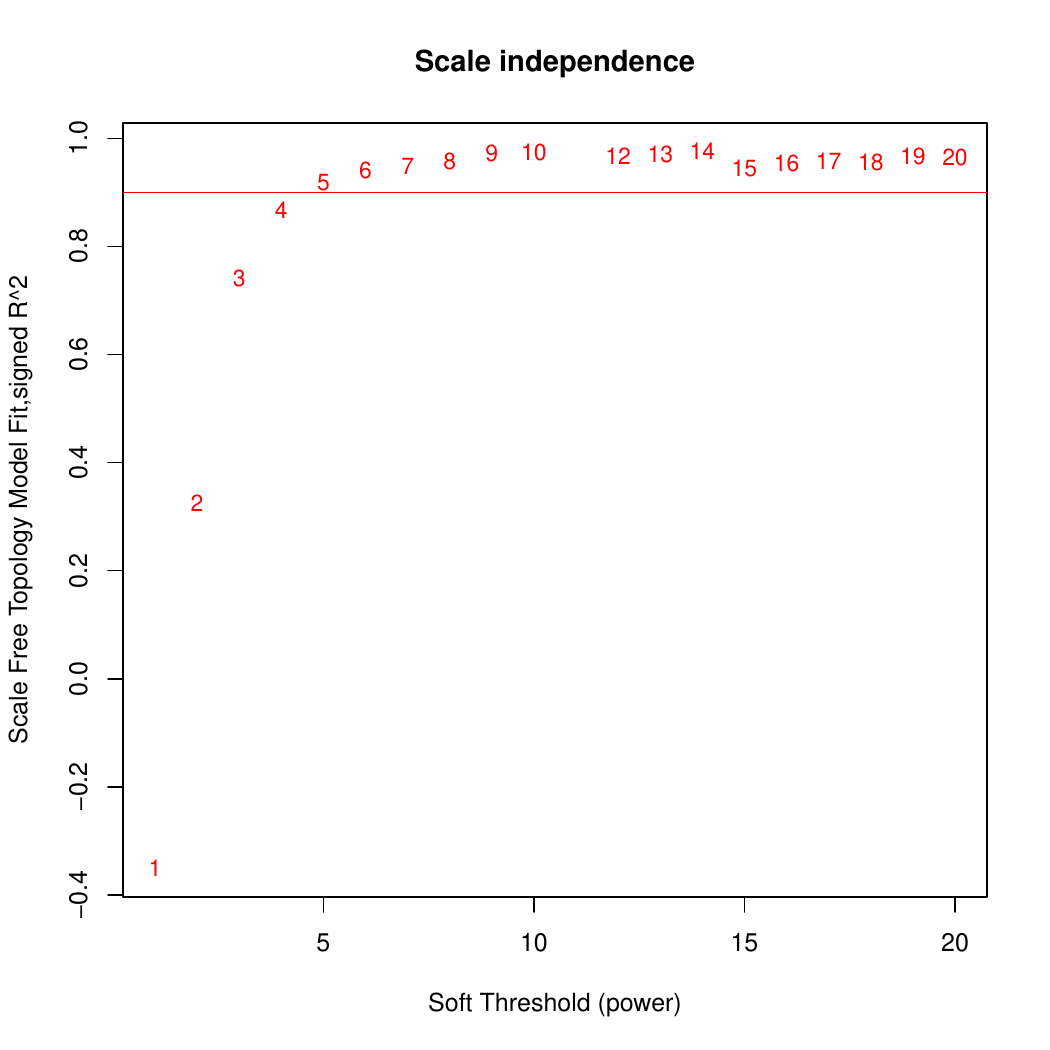
When return = TRUE, this saves diagnostic plots to
Results/. First, the scale-free topology fit used to pick
the WGCNA soft-thresholding power:
Then the TF clustering dendrogram, colored by module, before and after merging highly correlated modules:
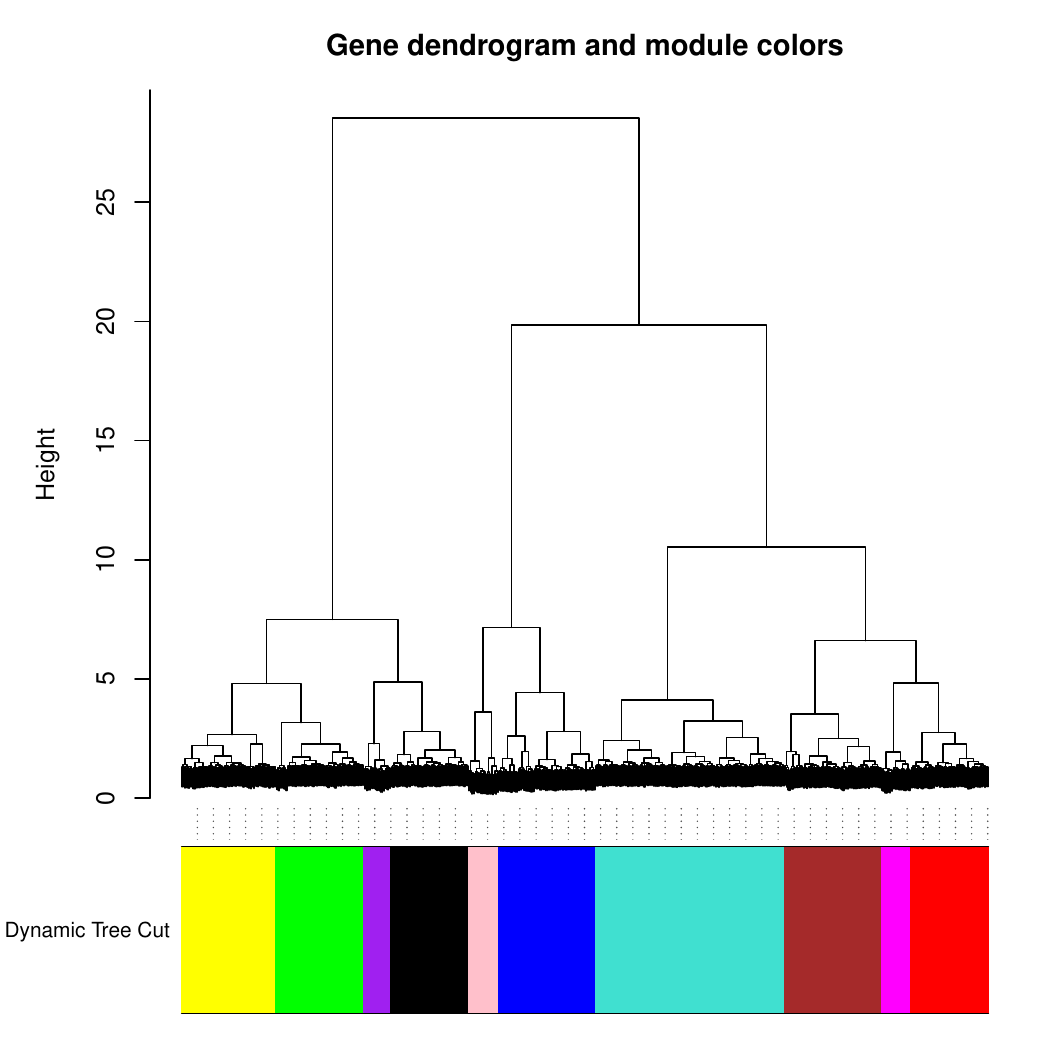
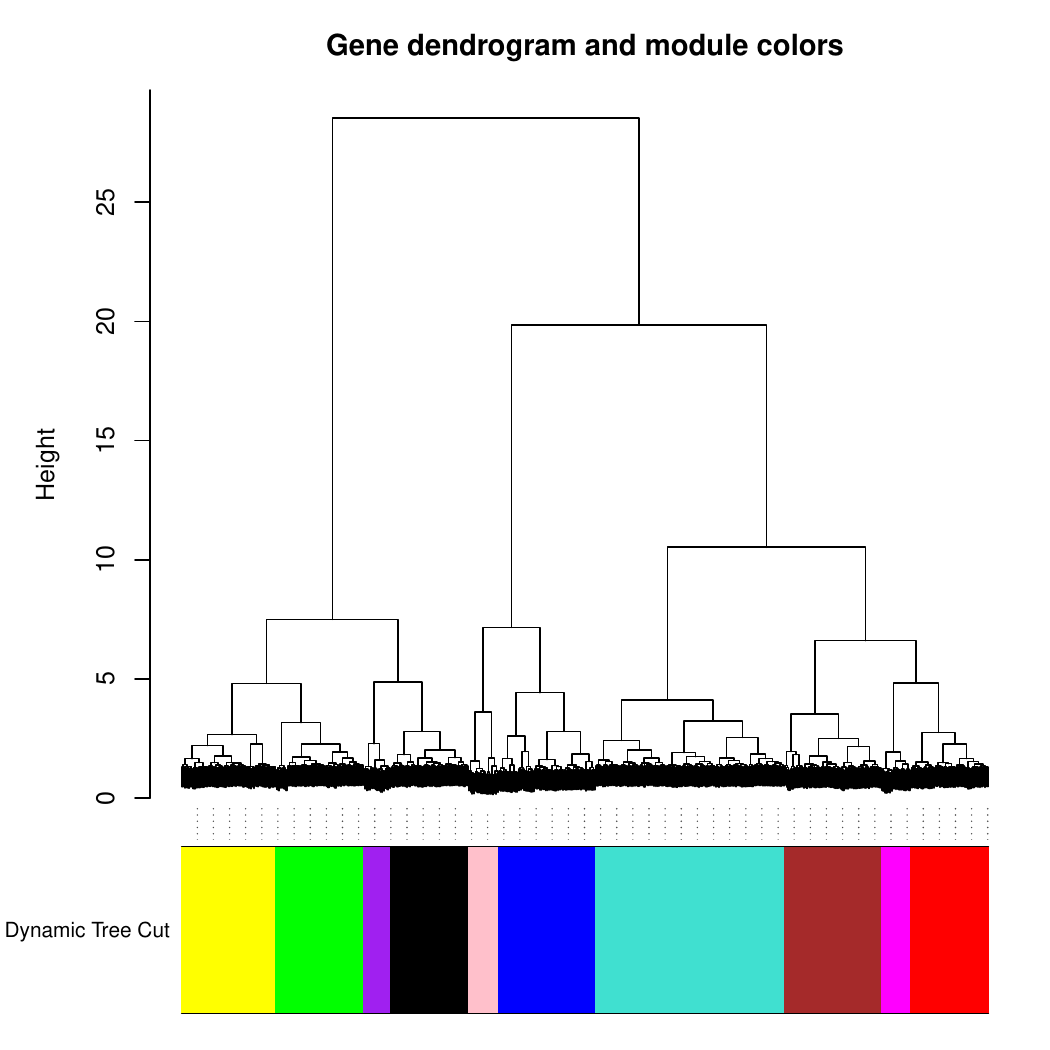
network[[1]] ("TFs module matrix") holds
the module eigengene scores (samples x modules) used downstream by
construct_cell_groups().
5. Pathway activity
Pathway activities are estimated with
compute.pathway.activity(), using a multivariate linear
model (MLM) via decoupleR (Badia-i-Mompel et al.
2022), with PROGENy (Schubert et al. 2018) as the default
pathway database. If a custom gene_sets list is supplied,
GSVA scoring is computed in addition to PROGENy.
Key arguments:
-
RNA.tpm— normalized expression matrix (genes x samples). -
gene_sets— optional list of custom gene sets; if provided, GSVA scores are also returned. -
paths— optional custom PROGENy-style pathway-gene weight table; ifNULL, the default human PROGENy model is used.
pathways <- compute.pathway.activity(
  RNA.tpm = counts.norm,
  return  = TRUE
)
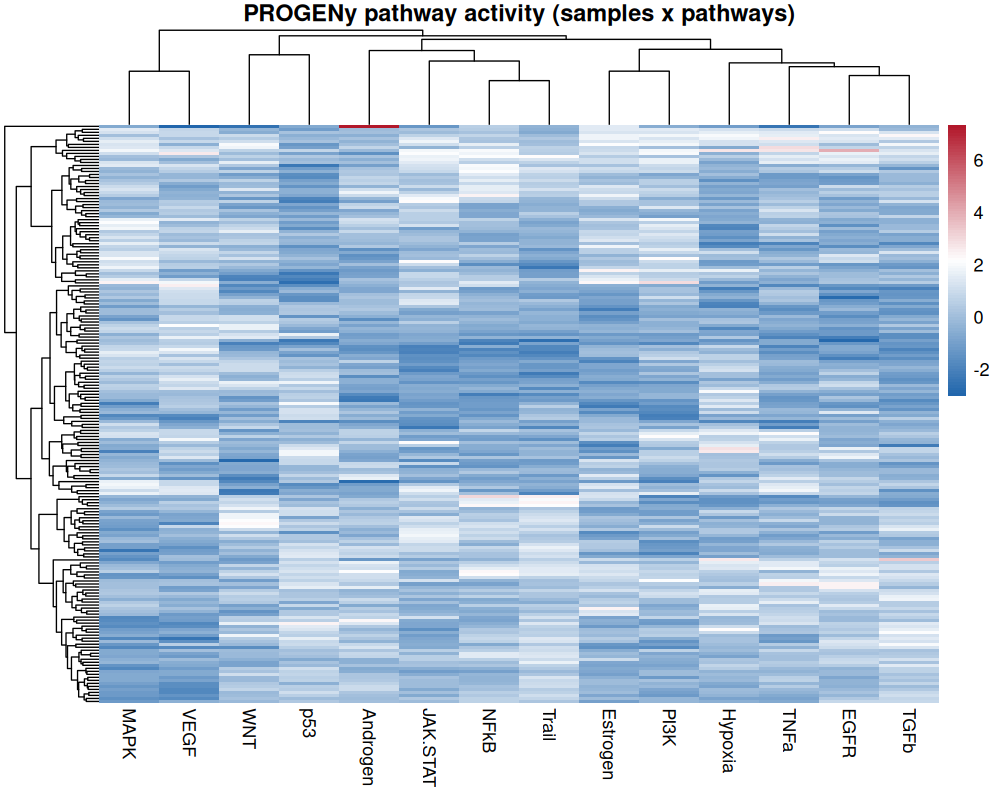
The result is a samples x pathways score matrix (14 PROGENy pathways by default). Clustering samples and pathways on this matrix gives a quick overview of which pathways co-vary across the cohort:
6. Deconvolution feature reduction
Deconvolution features from different methods/signatures are often
highly correlated. compute.deconvolution.analysis() (from
multideconv) groups correlated cell-type/method columns
into subgroups, reducing redundancy and improving
statistical power in later steps.
Key arguments:
-
deconvolution— output ofcompute.deconvolution(). -
corr— minimum correlation to group features into the same subgroup. -
corr_type—"spearman"(default) or"pearson". -
batch— optional batch/cohort vector; if provided, correlations are computed as partial correlations controlling for batch (see Batch/Multi-cohort Analysis).
dt <- multideconv::compute.deconvolution.analysis(
  deconvolution = deconv,
  corr          = 0.7,
  seed          = 123,
  return        = FALSE
)
7. Cell group construction
construct_cell_groups() combines the TF module network
(network) and reduced deconvolution structure
(dt) into composite cell groups: clusters
of cell-type features whose abundance correlates with specific TF module
activity. It correlates cell-type subgroups against TF modules,
hierarchically clusters the significant pairs, and cuts the resulting
dendrogram into cell groups.
cell_groups <- construct_cell_groups(
  network = network,
  dt      = dt,
  pval    = 0.05
)
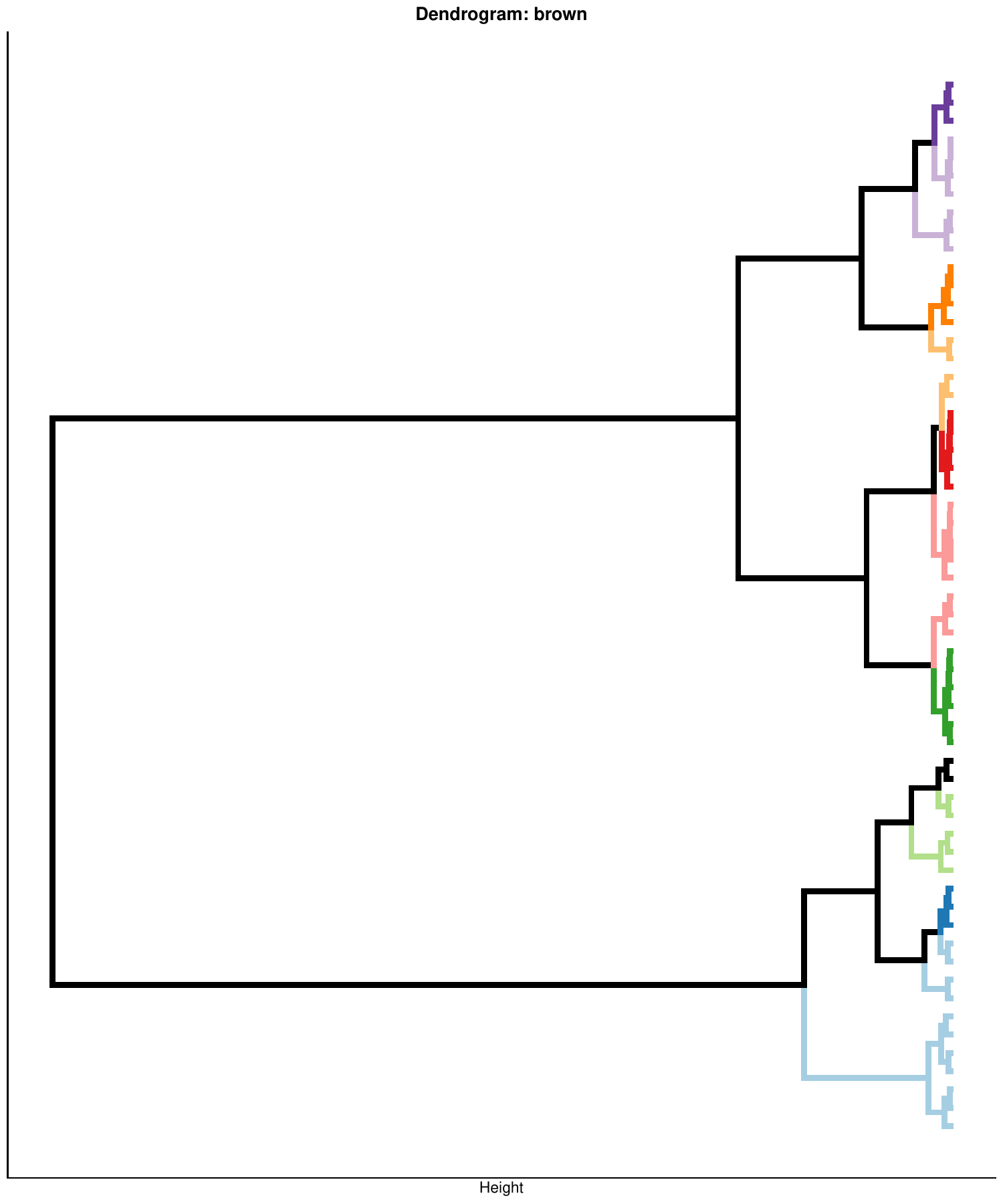
One dendrogram is produced per TF module, showing how its correlated cell-type features cluster into cell groups (colors indicate module membership of the underlying TF driving each branch):
See the Cell Group Construction article for full details, including the difference between unsupervised and supervised construction.
8. Latent factor extraction
Cell group scores are further compressed into a small set of
non-negative matrix factorization (NMF) latent factors,
a compact representation of the TME landscape used for downstream
statistics and machine learning, via
compute.latent_factors(). See the Cell Group Construction article for a
full walkthrough.
9. Cell niche characterization
compute_cells_niches() characterizes each latent factor
by identifying which cell types are enriched among the cell groups that
contribute most to it. See the Cell Group
Construction article for a full walkthrough.
10. Functional and meta-program annotation
compute_factor_gsea() and
map_factors_to_metaprograms() functionally annotate latent
factors via Hallmark GSEA and map them onto reference cancer
meta-programs derived from TCGA. See the TME State Characterisation article for a
detailed walkthrough, including the biological rationale, references,
and example plots behind meta-program mapping.
Putting it together
Every function above is called, in this order, by
CellTFusion(). Once you are comfortable with the individual
building blocks, you normally do not need to run them manually — simply
call:
res <- CellTFusion(
  raw.counts     = raw.counts,
  normalized     = TRUE,
  coldata        = traitdata,
  task           = "unsupervised",
  deconv_methods = c("Quantiseq", "Epidish"),
  TF.collection  = "CollecTRI",
  cancer_type    = "skcm",
  corr           = 0.7,
  corr_mod       = 0.9,
  pval           = 0.05,
  file_name      = "Tutorial",
  return         = TRUE
)
res then contains every intermediate object described
above ($Deconvolution, $TFs_matrix,
$TF_network, $Pathways_scores,
$Processed_deconvolution, $Cell_groups,
$Latent_spaces, $Cells_niches,
$TME_states, $Metaprograms_reference) — see
the README for the full output
structure.